Millions of residents across New York City and much of the northeastern United States were ordered to stay home Monday as a powerful winter storm unleashed heavy snowfall, high winds and dangerous whiteout conditions. Officials issued road travel bans, declared states of emergency and suspended public transit as forecasters warned the storm could rapidly intensify into a “bomb cyclone.”
Travel Bans, Airport Disruptions and Widespread Closures
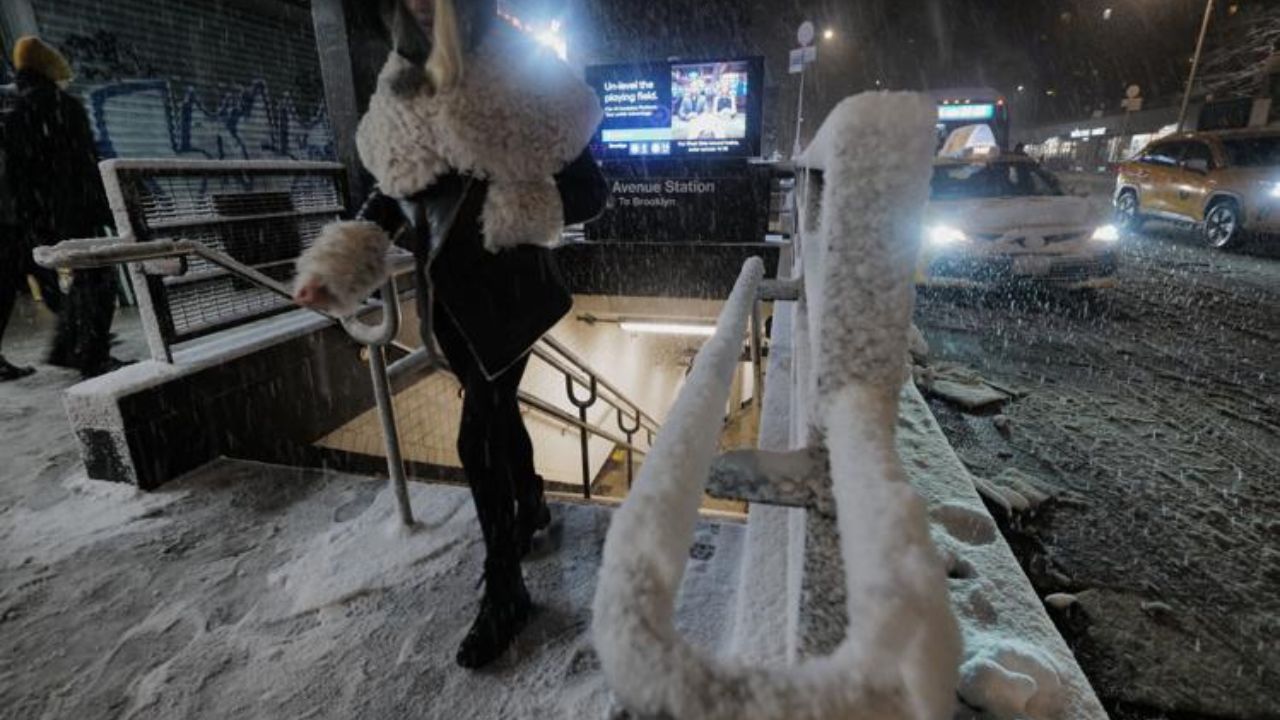
Cellphones across New York City blared emergency alerts Sunday night warning of a ban on non-emergency travel on all city streets through noon Monday due to “dangerous blizzard conditions.” Similar restrictions were implemented in Rhode Island and New Jersey as snow intensified overnight.
Regional airports reported widespread cancellations and delays, while some public transportation systems were temporarily shut down. Even delivery services paused operations, with DoorDash announcing it would suspend deliveries in New York City overnight because of the worsening storm.
Blizzard warnings stretched from Maryland to Maine as the system moved northward. The National Weather Service projected between 1 and 2 feet (30 to 60 centimeters) of snow in many areas, with snowfall rates potentially reaching 2 inches per hour at peak intensity. Officials repeatedly urged residents to avoid unnecessary travel.
Storm Could Become a “Bomb Cyclone,” Meteorologist Warns
Meteorologists cautioned that the storm was strengthening rapidly and could meet the definition of a bomb cyclone — a system that drops at least 24 millibars in atmospheric pressure within 24 hours.
“The storm is continuing to develop, and as it does, as it continues to strengthen and move to the north, we’re expecting conditions to rapidly deteriorate,” said Frank Pereira, a meteorologist with the weather service.
“We’re expecting it to drop by that magnitude at least over the course of the next 24 hours. I think when all is said and done, it will meet the definition of a bomb cyclone.”
The heaviest snowfall was forecast to occur overnight before gradually tapering off Monday afternoon. Strong wind gusts combined with heavy, wet snow raised concerns about damaged trees and prolonged power outages, particularly southeast of the Boston-Providence corridor.
“Winds like that, combined with heavy, wet snow, are a recipe for damaged trees and prolonged power outages,” said Bryce Williams, a meteorologist with the National Weather Service’s Boston office. “That’s what we’re most concerned with.”
Emergency Declarations and Public Safety Efforts
Emergencies were declared in New York, Philadelphia and several other cities, along with states stretching from Delaware to Massachusetts. Officials mobilized plow crews, emergency responders and utility workers in preparation for extended cleanup operations.
New York City and Boston canceled public school classes for Monday, while Philadelphia shifted to online learning. New York Mayor Zohran Mamdani described it as the city’s “first old-school snow day since 2019,” urging children to “stay cozy” while crews worked to manage accumulating snow.
Outreach workers in New York City moved to bring homeless residents into shelters and warming centers ahead of the storm’s peak intensity. Major landmarks and cultural institutions also announced closures, including the Museum of Modern Art in New York and Arlington National Cemetery in Washington, D.C. Broadway performances scheduled for Sunday evening were canceled.
Major Snow Clearing Operations Underway
City officials began large-scale snow removal operations Sunday night, recruiting additional workers to shovel sidewalks and clear key areas before the first heavy wave of snowfall fully arrived.
Private snow management companies also prepared for extended operations. John Berlingieri, owner of Berrington Snow Management on Long Island, canceled a planned family trip and readied his fleet of 40 front-end loaders for what he expects could be at least a week of nonstop work.
“I’m anticipating at least one week of work around the clock,” Berlingieri said. “We’re going to work 24 to 36 hours straight, sleep for a few hours and then go back.”
What Comes Next
Forecasters expect conditions to improve gradually by Monday afternoon as snowfall tapers, though lingering high winds and potential power outages may persist. Officials are monitoring infrastructure impacts and will assess damage once visibility improves.
Authorities continue urging residents to remain indoors, conserve energy and report outages as cleanup efforts ramp up across the region.
The storm’s intensity and potential bomb cyclone classification underscore the seriousness of the event, marking one of the most significant winter weather threats to hit the Northeast in recent years.