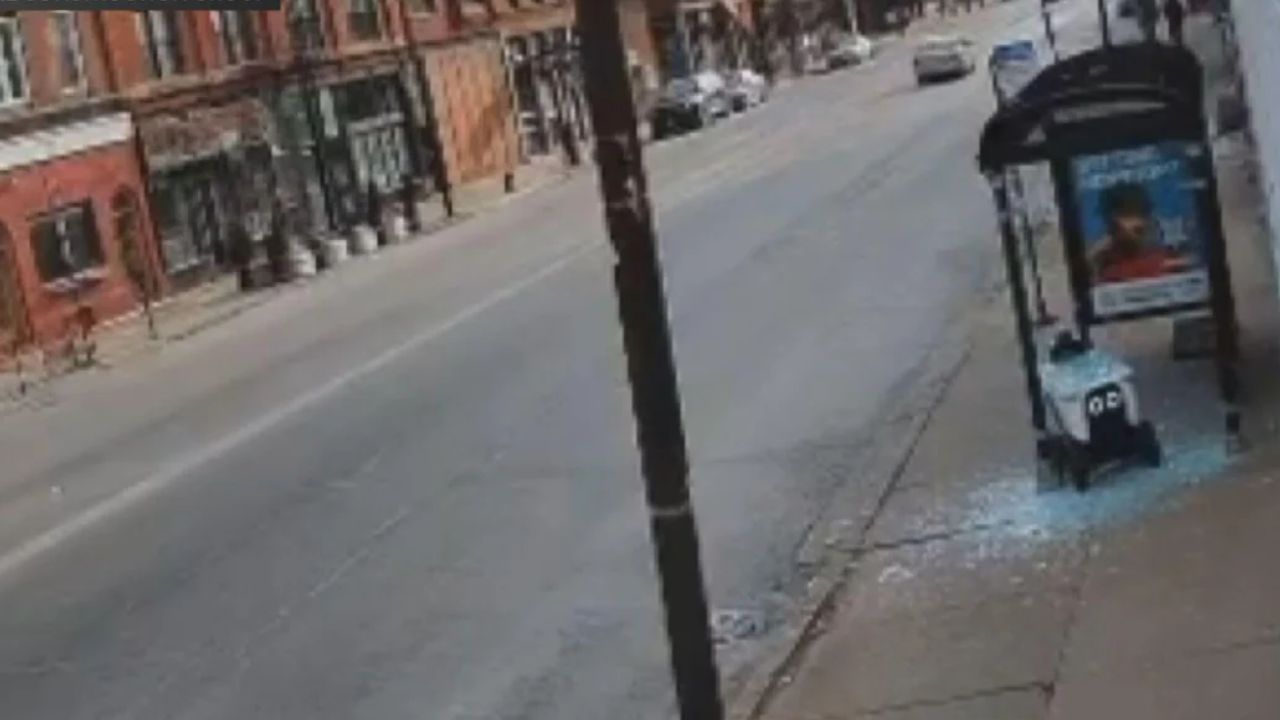
Chicago, Illinois: A small autonomous food delivery robot is making big headlines after crashing into a CTA bus shelter in West Town, shattering a large glass panel and scattering debris across the sidewalk. While the unusual incident quickly gained attention online, it has also intensified debate over the safety and future of sidewalk delivery robots operating under a city pilot program.
The crash occurred at the busy intersection of Grand Avenue and Racine, just outside Centre Construction Group. Surveillance footage shows the compact, wheeled robot rolling directly into the glass panel of the bus shelter, breaking through it with enough force to leave a noticeable mess on the pavement.
Bayard Elfvin, CEO and founder of Centre Construction Group, witnessed the aftermath and admitted he was surprised by the impact.
“I was shocked that something that small could hit the glass that hard and go straight through it,” Elfvin said. “You don’t expect a delivery robot to cause that kind of damage.”
Although no injuries were reported, the shattered glass raised immediate safety concerns, particularly given the high foot traffic at the bus stop. Commuters often wait at the shelter during peak hours, and the incident could have resulted in serious harm if pedestrians had been standing near the impact point.
Company Response and Investigation Underway
Serve Robotics, the company behind the robot involved in the crash, released a statement confirming that the robot made contact with the glass and that its local team quickly responded to clean the area. The company described the incident as extremely rare and emphasized that its robots have completed hundreds of thousands of deliveries since 2025 without a single serious incident.
The company also confirmed it will cover the cost of the already repaired bus shelter glass and is conducting a full investigation to determine what caused the malfunction or navigation error.
Meanwhile, footage captured later showed a robot from a different delivery company successfully navigating the same stretch of Grand Avenue without incident, suggesting that not all systems are experiencing similar issues.
City Officials Weigh Safety and Public Feedback
The incident has drawn attention from local officials, including Ald. Walter Burnett of the 27th Ward, where the crash occurred. Burnett stated that public safety remains the top priority as the pilot program continues.
City leaders are reportedly in communication with the company and the bus shelter provider to ensure repairs are handled properly and that monitoring procedures are strengthened. Burnett noted that the city will evaluate the robots’ compliance with safety protocols before deciding whether the pilot program should continue beyond its trial phase.
Currently, the pilot program allowing sidewalk delivery robots is scheduled to run through May 2027. Officials say they will rely heavily on resident feedback and performance data before making a final determination.
Growing Opposition and Petition Movement
Not everyone is convinced the program should move forward. A grassroots petition calling for an end to robot deliveries has gathered more than 3,700 signatures, according to organizer Josh Robertson.
Robertson argues that the recent crash is not an isolated concern but part of a broader pattern of complaints about safety and accessibility. He claims residents have reported numerous issues, including robots blocking sidewalks, interfering with mobility devices, and creating potential hazards for pedestrians.
“This was dramatic and highly visible,” Robertson said of the bus shelter crash. “But for many Chicagoans, it’s just one more example of the disruption these robots have caused.”
In a separate development, Ald. Daniel La Spata of the 1st Ward indicated that the program would not be expanding in his ward after a survey showed most residents opposed continued deployment.
The Bigger Question: Are Sidewalk Robots Ready?
Autonomous delivery robots are increasingly being tested in major cities as companies look for cost-effective and environmentally friendly last-mile delivery solutions. Proponents argue that the robots reduce traffic congestion, cut emissions, and provide efficient food and package delivery.
However, critics say the technology may not yet be fully prepared for dense urban environments like Chicago, where unpredictable pedestrian movement, uneven sidewalks, heavy traffic, and crowded intersections create complex navigation challenges.
The West Town crash highlights a key issue in urban robotics: even small devices can pose risks when operating in public spaces. Glass bus shelters, busy intersections, and crowded sidewalks leave little margin for error.
For now, the pilot program continues, but the incident has clearly amplified scrutiny. As city officials monitor performance and residents voice their concerns, the future of sidewalk delivery robots in Chicago remains uncertain.
One thing is certain: a small robot’s unexpected crash has sparked a citywide conversation about technology, safety, and the balance between innovation and public protection.