
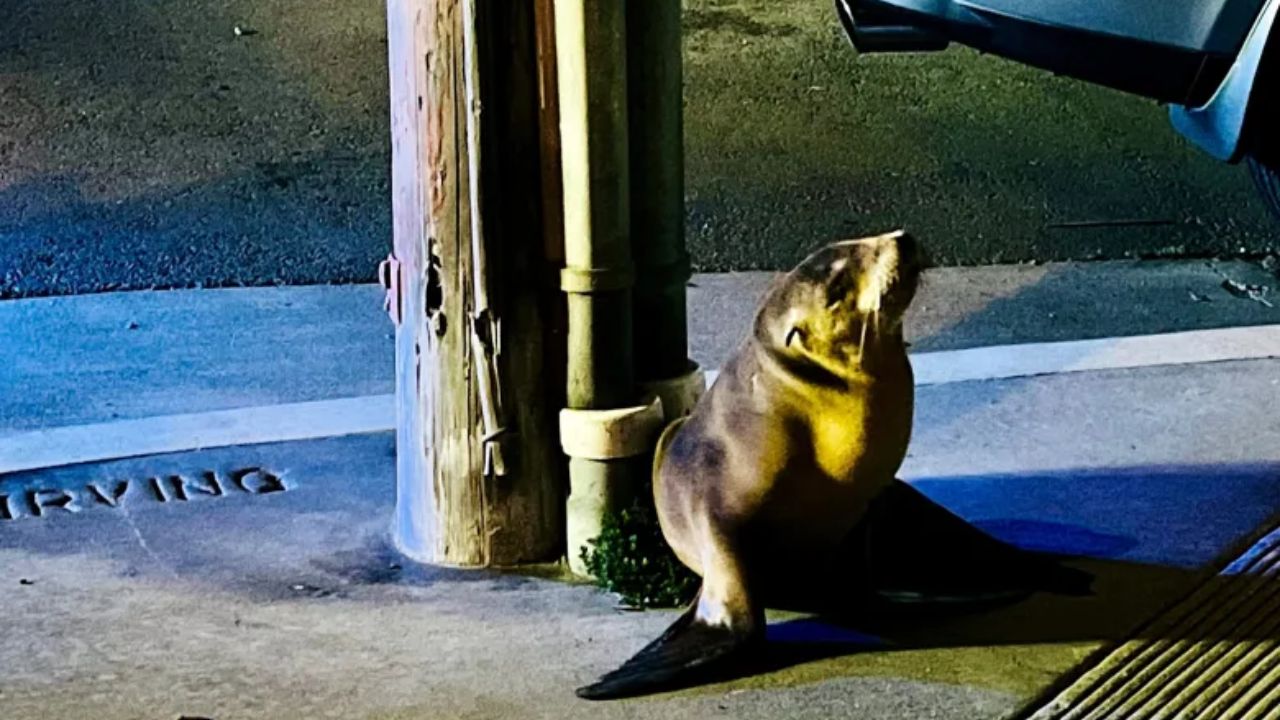
Residents in San Francisco’s Outer Sunset neighborhood woke up to an unusual and surprising sight early Thursday morning — a sea lion casually roaming city streets far from its ocean home.
The incident unfolded near 48th Avenue and Irving Street, where flashing lights and responding officers quickly drew attention. What initially seemed like a routine police presence turned into something far more unexpected when authorities were seen trying to safely contain a wandering sea lion.
What Happened
According to officials, the sea lion had somehow made its way out of the Pacific Ocean and into a residential part of the city. Officers, along with park rangers, worked together to guide and safely secure the animal, which appeared calm but curious.
Instead of a dramatic rescue, the situation resembled a careful and patient effort. Authorities located a large dog crate and successfully used it to contain the sea lion pup without harm. The animal was then transported to a nearby ranger station and kept in a safe holding area.
The young sea lion has since been given the name “Irving,” inspired by the street where it was found.
Rescue and Care Efforts
Wildlife experts from the Marine Mammal Center later took custody of Irving. At this stage, officials have not confirmed whether the sea lion is male or female, and further health evaluations are ongoing.
Initial observations suggest that Irving may be in relatively healthy condition, though experts are continuing to monitor for any signs of illness or distress.
Why Did the Sea Lion Come Ashore?
Marine experts say such behavior, while unusual, is not entirely unheard of. Daniel Costa, a professor of ecology at University of California, Santa Cruz, noted that sea lions have increasingly become more comfortable around humans over time.
He explained that the population of California sea lion has grown significantly since the Marine Mammal Protection Act was enacted. As a result, some sea lions display more curiosity and less fear, occasionally venturing into human spaces.
Costa also compared their behavior to energetic domestic dogs, describing them as playful and food-driven animals. However, he emphasized that despite their approachable appearance, sea lions are still wild animals and can become aggressive if they feel threatened.
Possible Concerns
While Irving appears stable, experts are not ruling out potential issues such as disorientation or exposure to environmental factors. One concern sometimes seen in marine mammals is domoic acid exposure, a toxin that can affect their behavior. However, no confirmation has been made in this case.
Another possibility is that young sea lions like Irving may simply be exploring beyond their usual habitat, especially as populations grow and competition for resources increases.
Public Safety Reminder
Officials are reminding residents to maintain a safe distance from marine wildlife. Even seemingly calm animals can react unpredictably if approached or cornered.
What Happens Next
The goal is to rehabilitate and release Irving back into the Pacific Ocean once it is deemed safe and healthy. For now, the focus remains on monitoring the sea lion and ensuring it receives proper care.
What began as a surprising early morning encounter has turned into a hopeful rescue story — one that highlights both the growing interaction between wildlife and urban life, and the importance of handling such situations with care.