
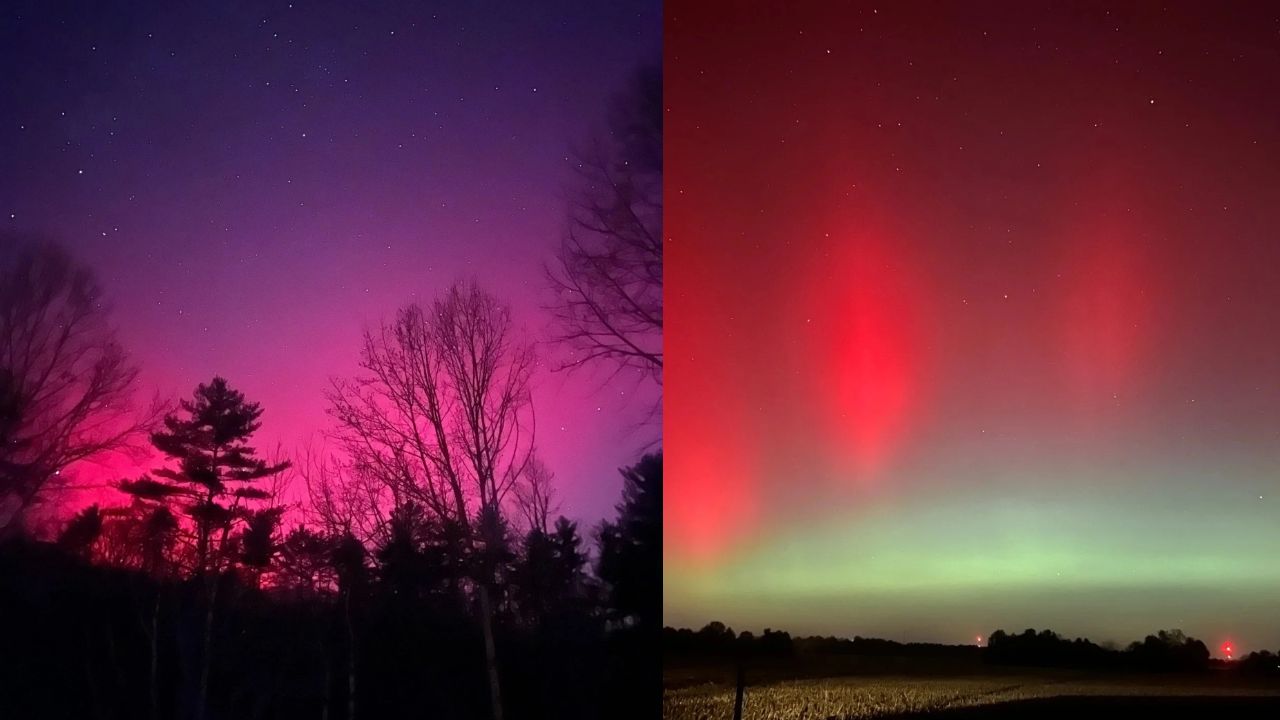
MINNEAPOLIS, Minnesota — The night sky could put on a rare and stunning show this week — and you do not want to miss it.
A fast-moving stream of solar wind is pouring out of a massive coronal hole in the sun’s atmosphere. That stream is expected to reach Earth on Thursday and Friday, potentially sparking a geomagnetic storm strong enough to push the Northern Lights into view across parts of the northern United States.
Which States Could See the Northern Lights
The National Oceanic and Atmospheric Administration (NOAA) has issued a Geomagnetic Storm Watch for both nights.
According to NOAA’s Space Weather Prediction Center, residents in these seven states have a real chance of seeing the aurora borealis:
- New York
- Idaho
- Michigan
- Minnesota
- North Dakota
- Montana
- Washington
If you live in or near any of these states, Thursday and Friday nights are worth staying up for.
When to Look Up
Timing matters. NOAA says the strongest geomagnetic activity is expected between 11 p.m. and 2 a.m. EST.
The solar wind is expected to keep hitting Earth’s magnetic field into Friday night as well, so there may be a second window if Thursday’s skies do not cooperate.
What the Northern Lights Actually Are
The Northern Lights — scientifically known as the aurora borealis — happen when charged particles from the sun slam into Earth’s magnetic field and atmosphere.
NASA describes them as a colorful and visually stunning display born from an intricate interaction between particles and magnetism connecting the sun and Earth.
In short, it is one of the most breathtaking things nature can produce — and it is free to watch.
How to Give Yourself the Best Chance of Seeing Them
Even during a strong geomagnetic storm, seeing the Northern Lights is never guaranteed. Cloud cover, light pollution and how Earth’s magnetic field responds to the incoming solar wind all play a role.
Here is what experts recommend to improve your odds:
- Get away from city lights. Find an open area far from streetlights and buildings.
- Lie flat on your back. Look straight up and take in as much sky as possible.
- Give your eyes time. It takes about 30 minutes in the dark for your eyes to fully adjust.
- Use your smartphone camera. Phone cameras can often pick up faint auroras that are completely invisible to the naked eye — so even if you cannot see much, point your camera at the sky and check the screen.
Do Not Wait Too Long
Geomagnetic storms are unpredictable. Cloud cover can roll in quickly, and the window of strongest activity is only a few hours long each night.
If skies are clear in your area Thursday or Friday night, step outside after 11 p.m. and look north.
It could be one of the most memorable things you see this year.
Have you ever seen the Northern Lights, or are you planning to look for them this week? Tell us in the comments — we want to hear from you.