
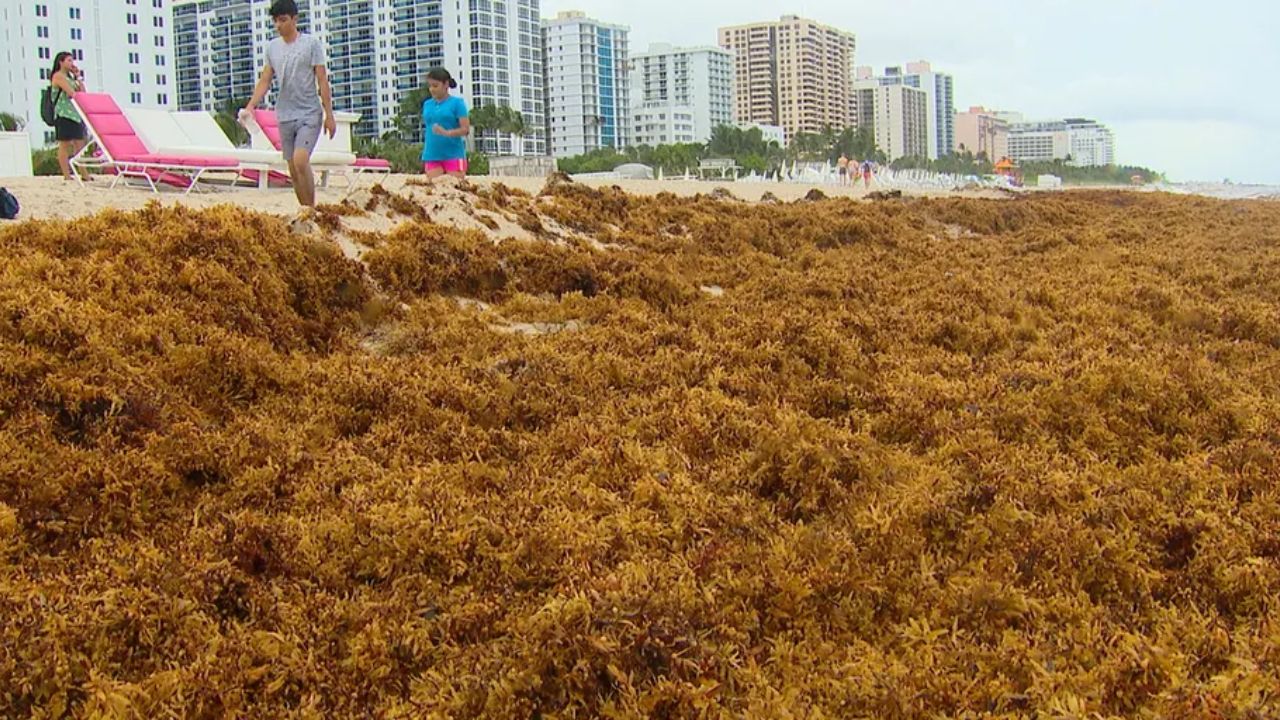
MIAMI BEACH, Fla. — If you’ve been near the water in South Florida lately, you’ve probably noticed the smell — a sharp, rotten-egg stench drifting off the shore. The culprit is sargassum, a brown seaweed piling up along Miami’s coastline in what officials say could become a record-breaking bloom.
And it’s not just unpleasant. It could be a health hazard.
What’s happening on the beach?
City of Miami Beach crews are out every day battling the accumulation. Workers drive tractors with rear-mounted blades along the shoreline during high tide, blending and dispersing the seaweed across the city’s 7.5-mile stretch of beach. In areas where it piles up heavily, crews switch to barber rakes to manually clear it.
Once removed and dried, the seaweed is hauled to a landfill.
Before any equipment rolls out, Miami-Dade County’s sea turtle conservation program surveys the area for nests and hatchlings — making sure cleanup doesn’t come at the cost of wildlife.
Why should you be concerned?
Sargassum isn’t just ugly and smelly — it carries real risks.
According to NOAA, as the seaweed decomposes on beaches, it releases hydrogen sulfide gas, which smells like rotten eggs. The Florida Department of Health warns the gas can irritate eyes, the nose, and throat — and poses particular risks for people with asthma or other respiratory conditions.
The seaweed can also contain arsenic, heavy metals, organic contaminants, and marine debris that may be harmful to humans.
How bad is it this year?
Very bad — and getting worse. Officials say the bloom has persisted for months, and Fort Lauderdale Beach is also seeing heavy accumulations. Sargassum season is expected to last throughout the summer, meaning relief isn’t coming anytime soon.
City crews say they’ll keep removing the seaweed as long as it keeps washing ashore.
For now, Miami Beach remains open — but if you’re heading to the shore, be prepared for the smell, and take note if you have any breathing sensitivities.
Quick Facts:
- Sargassum is a naturally occurring ocean seaweed that floats in large masses
- It commonly impacts Florida’s coastlines each year
- 2025’s bloom may be the largest on record
- Cleanup is ongoing across Miami-Dade County