- Late spring freezes are wiping out entire crops in a single night across the mid-Atlantic, leaving farmers with losses they cannot recover from.
- Unseasonably warm April weather is causing crops to bloom too early, making them far more vulnerable when cold snaps hit.
- An agricultural tech company called Brekland is developing a spray-on biodegradable foam that insulates buds and vines from freezing temperatures.
- The foam can protect crops for up to 24 hours and even releases a small amount of heat as it freezes — but farmers say speed of application is the next hurdle.
DUNDEE, New York — One night is all it takes. By morning, the buds are black, the vines are gone, and months of work have vanished.
That is the reality facing farmers across the mid-Atlantic as spring weather becomes increasingly unpredictable — and increasingly brutal.
Unseasonably warm stretches in early to mid-April are pushing crops to bloom earlier than usual. That sounds like good news. It is not. It leaves delicate buds exposed at exactly the wrong time, just when the threat of late-season freezes is still very real.
“The reality of it is you lose your entire crop in a single evening or hour — and that’s not recoverable,” said Patrick Redmond, Director of Vineyard and Nursery Operations at Hermann J. Wiemer Winery in Dundee, New York.
This Season, It Already Happened
The pattern played out in painful detail this spring.
Warm weather in mid-April triggered early growth across vineyards and farms. Then the cold arrived — fast and without mercy.
“It comes in and freezes everything, so then the next morning when you look at it, it’s just black,” Redmond said.
There is no coming back from that. The crop is gone.
A Spray Can Could Be the Answer
With so much at stake, a new technology is drawing serious attention from growers desperate for a solution.
Agricultural tech company Brekland is developing a spray-on, biodegradable foam specifically designed to protect crops from freezing temperatures.
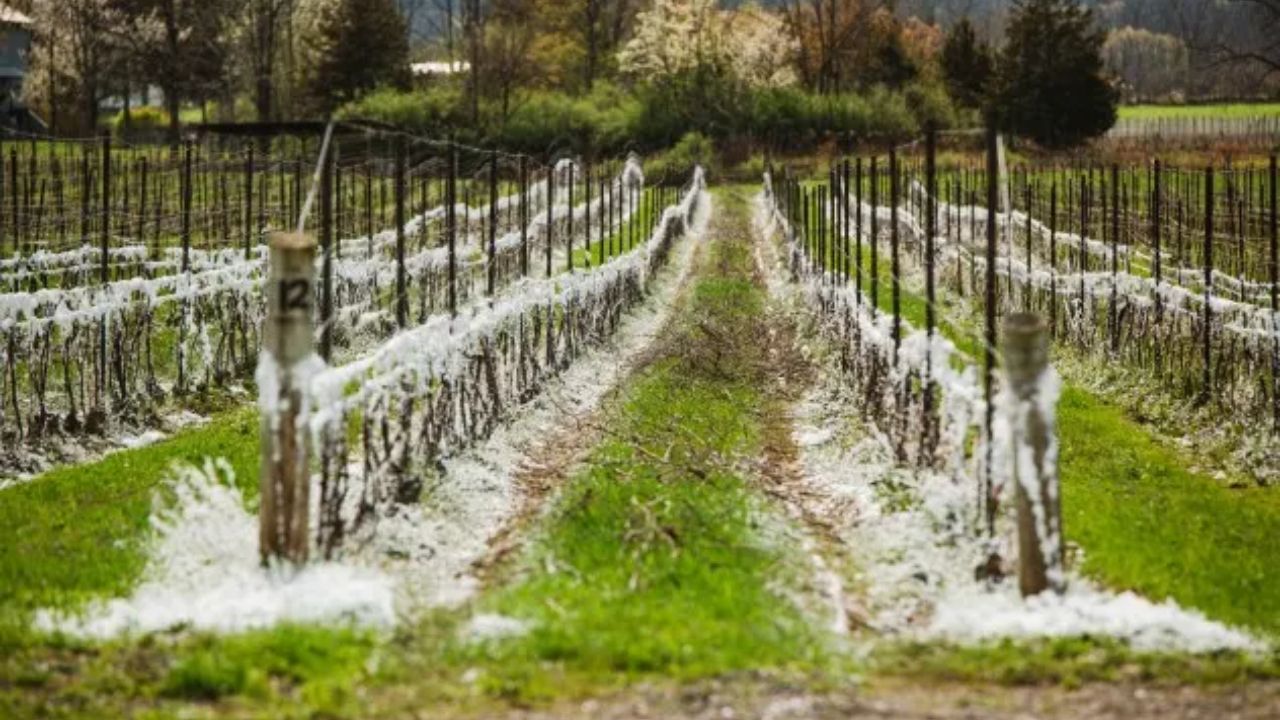
The foam is applied directly to buds and vines. It forms an insulating layer that traps heat and blocks frigid air from reaching the plant.
“The idea is that you apply this foam to these canes and buds, and then it provides an insulating factor,” Redmond explained.
But there is more to it than just insulation.
As the foam itself begins to freeze, it triggers an exothermic reaction — releasing a small burst of heat in the process. That extra warmth adds another layer of protection during the most critical moments of a temperature drop.
Combined, the two effects can shield crops for up to 24 hours. If freezing conditions continue, additional applications are possible.
The Next Problem to Solve
The foam works. That part is not in question.
The challenge now is speed — getting enough foam applied across large farm areas before temperatures fall too far.
“We know it works really well for us. It’s more about speed of application. How quickly can we apply an effective layer, and that’s the next step,” Redmond said.
Farmers Say This Is the New Normal
Growers are not treating this as a one-season problem.
As climate patterns keep swinging between early warmth and sudden cold, late spring freezes are becoming a predictable threat that farmers have to plan around every single year.
“These freeze events are going to keep happening. It’s not a problem that’s gonna solve itself or go away on its own. It’s gonna almost become an integral part of being able to produce vines,” Redmond said.
For farmers already stretched thin, a spray-on solution that can save a season — applied from the back of a truck the night before a freeze — could be the difference between a harvest and a loss.
Have you seen how late freezes are affecting farms or food prices in your area? Share what you know in the comments — local voices matter on stories like this.